
Where do you think your body burns the most calories? The gym? Running? That sweaty cycling session? What if I told you that most of the calories you burn are used just to keep you alive, even if you don’t leave your bed? In this video, we will uncover where your energy goes. Why workouts burn far less than most people think, and how simple daily movements could quietly burn hundreds of extra calories without a single workout. If the weight is not shifting despite all your effort, that might be the missing link. I am Dr. Almary, a weight loss surgeon, help you understand the science behind obesity and your health.
Let’s break this down. How does your body use the energy from the food you eat? Think of your body like a wooden house. Each day, a truck drops off loads of wood logs. That’s your food. Some logs are used to repair the house. Others go into the fireplace to keep it warm, and other parts will go to the generator to power, and that generator creates electricity in the house that will power the lights, appliances, etc. That is your metabolism. It pulls energy from your food and uses it to keep you alive, to keep you warm, to keep everything running and functioning throughout the day. The total amount of energy your body burns each day if you picture it like a pie. It’s made up of three slices. Let’s look at each slice and what that means for weight loss.
Energy pie chart - where do your calories go
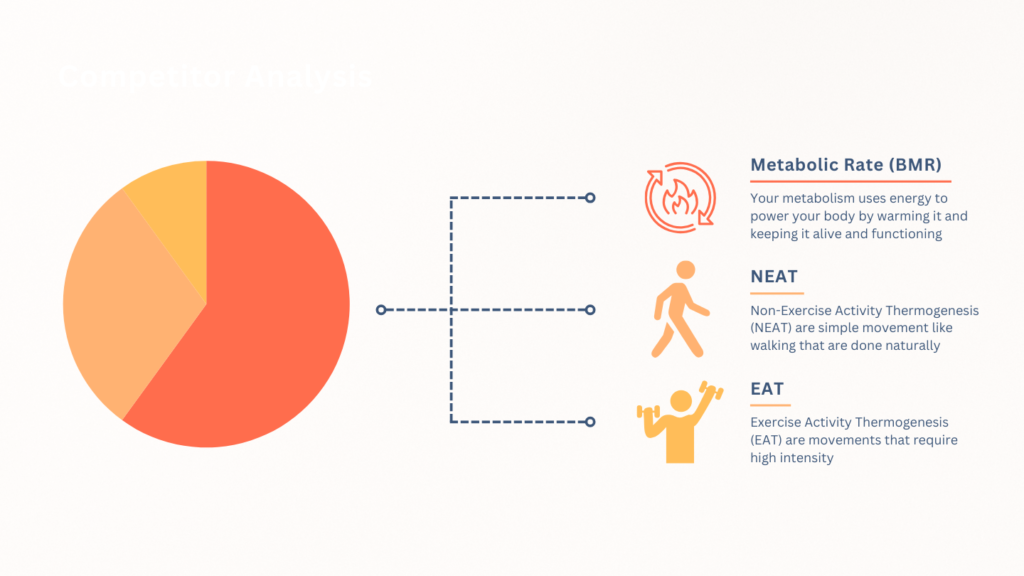
The first and main slice of the pie goes to the basal metabolic rate or BMR. Think of your body like a house with appliances running 24/7. Even when nobody is at the house. Even when you’re not doing anything inside the house, you’re still using energy. That is your basal metabolic rate. It’s the energy your body uses just to keep you alive, to run your heart, to keep the brain functioning, the lungs working, and the stomach digesting. And here is the part most people don’t realise. This silent system, this kind of background work, uses up the biggest chunk of the energy that we use every day. Now here comes the key question. Can you change your basal metabolic rate? The answer is yes and no. Now, some parts which influence the basal metabolic rate are fixed, like your age, your height, your gender, and your genetics. But other factors can shift your BMR. Things like your muscle mass, previous dieting, calorie restrictions that you’ve been through, your sleep pattern, and your stress levels, all these can be influenced in a way that could change your BMR. Your body is always adjusting your survival engine depending on how safe, nourished, or threatened it feels. We’ll dive deeper into how and why that happens and what you can do about it in our next blogs.
The second chunk of energy use goes to what we call NEAT. This is the short for non-exercise activity thermogenesis. It’s just a scientific way of saying the calories that you burn during your daily activity, which are not part of a formal training or a formal workout. It’s a kind of background movement in your day. The little things that you do without even thinking about them. something like walking to the kitchen to make a coffee, climbing up stairs, or just standing instead of sitting. Here is an analogy that hopefully will make it a little bit easier for you to understand what we mean by neat. Imagine your daily energy burn is like a bathtub being filled. So you might think that the biggest tap is the workout, that kind of of 30-minute hit gym session, but neat is like the second tap that’s running in the background throughout the day. Not dramatic, but constant. And at the end of the day, all these like small drips can add up and fill your bathtub. Meat can contribute to about 30% of your daily calorie intake. Neat varies massively from one person to another. Let me give you a real-life example. Someone who works from home sitting most of the day at the desk working on a laptop would burn about 200 to 300 calories a day through the neat. But a nurse, a teacher, a parent who looks after a child, they are on the move all day, they might burn between 800 and 1,000 calories through that kind of neat energy use. If you are stuck and you are already eating well, exercising, look at your daily movements. It might not be about doing more workouts and going to the gym more. There are simple, practical ways to improve your needs in a day.
Exercise - the good and the bad
Now let’s talk about what most people think is the key to losing weight. That’s exercise. This is what we call EAT, short for exercise activity thermogenesis. It’s the energy that your body will burn through structured formal training or workouts. Something like going to the gym, running, cycling, swimming, and weightlifting. So, these are kind of like a formal training session. And don’t get me wrong, exercise is fantastic. It’s great for your heart, it will improve your mood.and helps with sugar control in our bodies. But when it comes to burning calories, it’s not as strong. Let’s say that you do three proper gym sessions in a week. Usually, if you’re working out between 30 and 40 minutes, you’re going to be burning something around 300 to 400 calories. That only makes about 5% to 7% of your total daily energy burn. And here is the problem. Most people think that exercise is the main key to fat loss. But unless you train like an athlete a few hours every day, it’s just a small slice of the pie. Not as significant as most people think. Now, let me explain why relying on exercise alone can hinder your weight loss journey.
The first one is what we call compensatory eating. After a tough workout, you would usually feel hungrier and without realising, you might eat back what you’ve just burnt or even more. So that kind of 400-calorie workout will be gone after you have a smoothie or a snack. The second thing you need to watch for is what we call indirectly reducing your need. After exercising, if you’re really tired, most of the time your body will kind of slow down and rest for the rest of the day. You’ll find yourself sitting a little bit more and moving a little bit less, and that will be the calories that will be cancelled out from your usual need expenditure. The third thing is the overestimation of the burn. Most people think that they have burned much more than they have. That kind of false sense of accomplishment sometimes might lead to a little bit of overeating or even skipping the next gym session. The other thing that you need to watch for is that it takes time.
Going to the gym, particularly if you are not used to going to the gym, takes a lot of work and planning. And when life gets busy, they are usually the first things that will drop from your schedule. And here is a danger. If you build the whole strategy of your weight loss around the fact that you need to go to the gym a few times a week and do a very heavy session, once you start skipping these gym sessions, you’ll start feeling that your plan is falling apart. And that mindset might make you feel that you should give up on the whole journey because it’s failing. So does that mean that you shouldn’t exercise? No.
How the little things matter
This is not what I’m trying to kind of push for here. But what I’m trying to explain is that exercise is one of the very best things that you can do for your body and your brain. Exercise is not a weight loss strategy. It is a health strategy to improve your general health, a muscle-preserving strategy that will increase the muscle mass that you have or a tool for long-term weight loss maintenance. If you’re trying to lose weight, the real game changers are your food choices or your daily movements. You don’t need long workouts or intense routines to keep your metabolism active. There is a much more flexible, realistic way to uplift your metabolism and support your weight loss, particularly when life becomes so hectic. That is by increasing your non-exercise activity thermogenesis.
These are the small everyday habits that you have embedded and built into your routines. You don’t try to change everything at once. You start with the small changes, and then you build on what you already have. Over time, these small actions will compound naturally into bigger results. Let me take you through some of the examples of how you could boost your needs and your usual energy use during the day uh without needing to dedicate time for these things. Small changes like taking phone calls when you are on the move. Particularly if you are in a quiet place where you can take the phone call and kind of pace around your office. If you are using your car to go to the supermarket, maybe try to park your car a little bit further from the entrance. Make a short walk to the entrance. Even if you are in the supermarket, if it is a small shopping, you don’t necessarily need to use the trolley for it. Maybe use the basket and try to lift it and walk around with it.
Now, here is something very powerful that you will find if you start adapting these changes. Every time you do one of these small habits, you’re not just burning a few extra calories, but you are reinforcing your identity. You would say that I am someone who takes care of my health. I am someone who would want to be healthier by using the stairs rather than the lift. Every time you do these small actions, you’re reinforcing your new identity as somebody who is healthy . Because weight loss is not just about big gains in a short time. It’s about small, constant changes over time that will give you maintenance and allow you to win this battle with the weight in the long run.
In the next blog, we’ll explore why it happens to lose weight, why the hunger increases, why the energy drops, and why the fat loss seems to become so difficult and slows down over time. Not because you are failing, but because your body is trying to protect its fat storage. Next time, we will show you how to work with your biology and fight back smarter. If this video made things clearer or gave you a new way to think about weight loss, please hit like, share it with someone who might find it useful, and subscribe for more insights about your health from a weight loss surgeon. See you next time.
Great post—highlighting that everyday movement can contribute far more to total calorie burn than a few gym sessions really shifts how we should think about fitness and energy expenditure. Everyday activities like gardening, cleaning, or walking can add significant burn through NEAT, which often outweighs formal workouts in a busy schedule. For people also considering weight-loss strategies or medication transitions, resources like https://www.islipsurgery.org.uk/best-places-to-switch-from-mounjaro-to-wegovy/
offer thoughtful insights into optimizing your overall plan.